Saturday, January 16, 2016

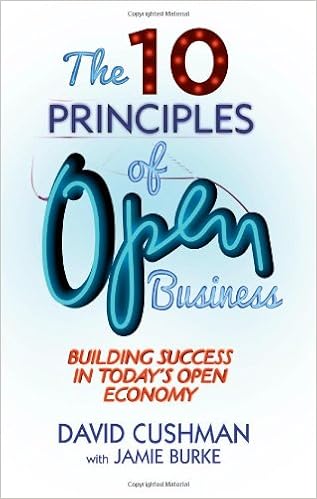
The 10 Principles of Open Business - in Chinese

I'm pleased to say the rights to publish The 10 Principles of Open Business in simplified Chinese have been sold to China Renmin University Press.
I'm really looking forward to seeing how it looks and delighted that the message is being shared with the world's most populous and fastest-growing nation.
I'm fascinated to see the results of that...

Labels:

Friday, June 6, 2014

A great week for Open Business

It's been an extraordinary week for raising the profile of Open Business.
At the start of the week I received my copies of the June issue of Admap - the magazine for marketing professionals. It includes a three-page feature on The 10 Principles of Open Business.

The same day I was sent a link showing an article referencing quotes from myself and The 10 Principles (and particularly Open Capital) was included in the June issue of the British Airways in-flight magazine Business Life.

And last night The Guardian published an article they asked me to write on Open Business and its role in the true sustainability of business.

2014 is turning out to be the year of Open Business.

Click here for all previous press references to the book.


Labels: , , ,

Tuesday, March 25, 2014

Open Business: The Podcast

Anne Hawkins and Eric Swain have been kind enough to interview me and put together a podcast on the subject of The 10 Principles of Open Business. It's published today.

It's number 57 in their series on The Social Media Show. Please go take a listen. Then let me know what you think?

Labels: , ,

Friday, March 7, 2014

New rules for Open Capital in the UK

The FT on Mar 11 on Open Capital - with links to The 10 Principles
The UK's Financial Conduct Authority (part of what the FSA used to be) yesterday confirmed new rules on crowd funding (or as we prefer to call it in The 10 Principles of Open Business, Open Capital).

At first glance they appear sensible - and not a million miles away from how Seedrs operates (which as of time of writing Open Business, was the only FSA approved platform in the UK).

Like Seedrs the FCA rules impose a limit on how much you can invest - as a percentage of your investable assets. The FCA sets that limit at 10%. In other words it won't let you bet your farm on a Crowd Funding proposition (and the FCA are talking about security and loan-based crowd funding, not simply funding the production and purchase of an item) no matter how passionately you may believe in it.

This is actually a higher level of restriction than that placed on most people taking a punt on the stock market. For example, when I recently invested in Royal Mail shares, no one made me sit an exam to check I could afford to lose the amount I was putting up. You may therefore reasonably ask why this test is being applied to the crowd, and how indeed this crowd differs from the one making online share transactions every day?

Having said that, I'd be all for the retro fitting of this test to anyone investing in the stock market. It may prevent the odd crash or two... (imagine it applied to the banks)

My only concern with singling Crowd Funding out in this way is that it leaves it in the 'hobby money' field - a place where people dabble for a bit of fun - which doesn't feel quite a match with backing your beliefs and all the attendant generation of new kinds of businesses which mean more to more of us, that my chapter on Open Capital describes.

That said, the FCA is not closing the door to those who really want to push the boat out. If you want to invest more than the 10% of the assets you have available you can - you just have to prove you are doing so having conducted due diligence and been given professional advice.

Labels: , , , ,

Friday, January 24, 2014

Win a copy of the 10 Principles of Open Business

To mark the UK launch date of the 10 Principles of Open Business I have another batch of copies to give away.
Here's how you can get your hands on one:

1. Two will go at random to anyone who has retweeted the following by 1am GMT on January 28, 2014:

"RT this for a chance to win The 10 Principles of #OpenBusiness - http://amzn.to/1eyDweN"

Two winners will be selected at random and sent physical copies of the book - worth £19.99 each. To qualify the amazon link must be included in the tweet, and the user of the twitter handle must be demonstrably human (bots need not apply). Qualifying tweets must be shared by 1 am GMT on January 28, 2014.

2. One copy will go to the person who gives the best reason for getting a freebie by commenting on this post, below.
The catch here is that you have to commit to writing a review (creating a video one if you prefer) for your own social channels AND add a review to amazon. Naturally you are free to publish what ever you like, you just have to commit to doing a review, good, bad or indifferent.

3. The final copy in this batch will go to someone who is prepared to read it, then hand it on to someone else who they think will get value from it. 
Ideally you'll make that a condition of giving it to the person you pass it on to (as will they, and so on). Just drop me your details and postal address to the gmail address you'll find at the top of the desktop version of this blog.

The deadline for 2 and 3 is February 24, 2014.

Labels: , , , ,

Monday, January 20, 2014

Edelman trust barometer results align with Open Business approach

Edelman's 2014 Trust barometer survey is out and with it vindication of a key trend we've been observing in Open Business.
The clear majority of respondents to the annual survey (84 percent) believe that business can pursue its self-interest while doing good work for society.

This very much aligns with what we explore in The 10 Principles of Open Business - particularly in the chapters on Purpose and Open Capital. Indeed - The 10 Principles argues that doing good for society offers a competitive advantage in our connected world.

More evidence that 2014 really could be the year of Open Business, perhaps?

From the chapter on Purpose:

There have never been greater drivers for businesses to become Purpose-led.

Apart from anything else, it will reconnect you with the world, re-tying those strands cut loose when CEOs first decided that shareholders mattered more than anyone or anything else.

“It’s a reversal back to the old days,” says Mark (Earls), “when corporations felt part of the world and felt a responsibility to it."


And from the chapter on Open Capital:

Peer-funded partnerships also offer the opportunity to create value beyond the back slap in the boardroom and the bottom line on the balance sheet; value creation which acknowledges resources are finite, that people, communities, societies and ecologies are connected and matter to each other.

And this in itself provides a genuine competitive advantage that the wisest global entrepreneurs are quick to identify. As Sir Richard Branson puts it: “…the boundaries between work and higher purpose are merging into one – where doing good really is good for business.”

In a connected world, where to win is to work together with ever greater numbers of people who care about the same things you do, few are going to sign up to support businesses which are damaging the ecosystem in which they exist – let alone support those organisations with their own money. Open Capital will therefore be a key driver of ‘doing good is good for business’.


Labels: , , , , , , , ,

Saturday, January 4, 2014

The role of Open Business in emerging holacracies

How Holacracy works - image from http://holacracy.org/how-it-works
With Ev Williams’ Medium and now Zappos going the Holacracy route, it’s no surprise this ‘new’ management model is getting attention from the likes of mashable
Its Flattened/No job titles/Goal-rather-than-management-led approach is an enviable fit with the more open business philosophy companies of this kind are comfortable and familiar with.
In many ways it’s simply putting a name to and combining many of the learnings those pursuing the 10 Principles of Open Business have already acquired. - but it may also provide a useful additional toolkit for the internal development of some Open Businesses.

The following brief extracts from my new book (out on January 28) The 10 Principles of Open Business,illustrate the point:

South African entrepreneur Arthur Attwell – found similar effectiveness from following the principle of Transparency:
“... you get a productivity boost from people who properly understand their importance to the company and the role they play. So many people – even unconsciously – think that they are just a tiny cog in a big machine.”
 “They feel an alienation from the products of their work,” says Arthur.
Without transparency it’s difficult for people to find meaning in their work. And without meaning there is little ambition and even less joy.
The job descriptions he offers people are just three lines long. There is no task-by-task list of things to do every day.
Everyone must have the ambition to own their space in his company.
“That’s why we don’t have job descriptions in the conventional sense. We have a maximum three bullet-points of functional responsibility. Some people have just one or two,” says Arthur.
“What that means is the things in those bullet points are your problem. It means people have to engage with more than just a narrow task list defined by key performance indicators,” adds Arthur.
“Make your people the boss of what they do.”
This will sound familiar to those trialling holocracy.

As will the impact of Principle 4: Shareability:
Definition: Packaging knowledge for easy and open sharing both internally and externally
Sharing is the cultural key to collaboration. It is where the organisational design principles of collaboration reside.
It is a principle which has the powerful benefit of flattening hierarchies, distributing responsibility and making the organisation more strategy and goal-led than management and task directed.
Shareability provides the tools for a radical re-organisation of resource. Deployed effectively it means people gravitate to what they care most about and can do most about. It can allocate people to work with their passions – generating a giant leap in effectiveness and productivity – not to mention morale.

And from the chapter on Principle 1: Purpose...
If every employee is clear about the Purpose of the org, if they express this in what they do and it is expressed in what they see of the behaviours of the business and of their colleagues, then they will be better able to make decisions which are truly aligned to the Purpose...
The decisions your people make are what drives the success of your business. Ensuring those decisions are made towards your shared goal (Purpose) is... more critical than ever.

Since we have seen that telling teams is not enough (and even less likely to succeed in distributed structures), ensuring they know the Purpose, through belief and behaviours, becomes even more essential.

Labels: , , , , , ,

Wednesday, December 18, 2013

10 Principles of Open Business half price until December 31


In the last few weeks I've been putting the final touches to The 10 Principles of Open Business - re-reading for final changes, selecting back cover quotes etc. 
I'm pleased to say it should be going to print any day now - ready for its launch date: Jan 28, 2014. (Feb 28 in the US. 
I've heard from a number of bloggers  offering to review - which is very kind and copies will go out to a handful in the New Year. 
In the meantime you can, until December 31, 2013, order your copy at 50% off*.
UPDATE: This offer is NOT meant to be available on books which are not yet published but in the case of The 10 Principles the publishers have agreed to offer the discount in advance of publication.


  • To get yours email palgravemacmillan@palgrave.com 

  • Mark your email for the attention of Vince
  • Make sure you tell him its The 10 Principles of Open Business you'd like to buy.
  • Vince will email you back offering the option of a form for you to complete or a phone call (during office hours) to take your order.
  • You must quote FESTIVE 13 for the 50% discount to be applied.
  • If you email before December 31 Palgrave Macmillan will honour the deal - even if your call to place the order happens in the first week of January.
My apologies to those of you who have tried to purchase this from the PM website and found the discount code did not work - we now know why.

*The discounted price is available to individuals only. This offer is not available to trade and library customers. Orders must be placed direct with Palgrave Macmillan

Labels: , , ,

Tuesday, October 8, 2013

Customer collaboration shifting from products to business strategy

There are still those who think the customer is a thing to be done to. Then there are also those who think that if a customer is to be listened to at all it is only to take part in a vote on stuff you've already decided to make or do.

And there are others still who are Open Business enough to consider allowing customers to shape products and services. This is the staple of the open door social media offers to business.

But business strategy? Surely that's one step beyond.

No. Not for a vast chunk of CEOs at the  highest performing businesses.

IBM's Customer Activated Enterprize report reveals that: "More than half of CxOs expect to open up their enterprises – bringing down barriers to extend collaboration inside and outside. 

Their most radical shift may be a new view on what it means to collaborate with customers."

The report is the result of interviews with  4,000 CEOs, CMOs, CFOs, CIOs a similar leaders from 70 countries and across 20 industries.  It reveals 60 per cent of CEOs plan to directly engage their customers and proactively apply what they learn to set their business agendas in the next three to five years.

Already 43 percent of CEOs include customers in the development of business strategies. 

And it's not just any old companies. IBM says there is a key correlation between the companies that succeed and their levels of external collaboration. Outperforming companies are 54 percent more likely to collaborate extensively with customers.

IBM's own story of collaboration features in my book, The 10 Principles of Open Business, available for pre-order today.


Labels: , , , , , , , ,

Thursday, September 19, 2013

If you can't be at our Open Business panel - watch here live

I'm hoping I will see many of the regular readers of this blog at one or more of the events I'm involved with for Social Media Week London - kicking off on Monday (September 23).
For details of all The Social Partners events (all at The Johnson Building, 77 Hatton Garden, London) follow this link
On it you'll find descriptions of each of our events along with availability. And if you find a sell-out (and there aren't many seats left for any of the events now) you'll note a little video camera icon against the events on Monday. That's because they will all be live-streamed.
These include my panel on Open Business with its all-star line-up (I'm not kidding, go take a look) and the premier of the results of in-depth research on the impact of social and digital on WOM and emerging behaviours,'Big Conversationalists'.
So if you can't be there in person, join us by the flickering light of your PC.

You can watch the Open Business Panel right here:

Labels: , , , , ,

Thursday, August 15, 2013

SMW London: Open Business and the Future of Community

Fire up your diaries - Social Media Week London looms and with it three events I'm taking part in - and more that I'd like to recommend.

First, I'm chairing a panel on Open Business (which given the forthcoming book makes a lot of sense).

On the panel (which starts at 1pm on Monday, September 23 at The Johnson Building, Hatton Garden, London) are:
Mark Earls (Author of  Herd: How to Change Mass Behaviour by Harnessing Our True Nature, I'll Have What She's Having, and Welcome to the Creative Age – Bananas, Business and the Death of Marketing). Mark is also winner of an Emerald Insights Award and a significant contributor to the chapter on Purpose in The 10 Principles of Open Business,.
Dave Coplin (Author of business bestseller “Business Reimagined: Why work isn’t working and what you can do about it” also joins us. He is Chief Envisioning Officer at Microsoft & The Envisioners).
Grey (London) CEO Chris Hirst will be there, too (Since his appointment as CEO in Jan 2010 Grey London has been the fastest large agency in London driven through significant new business success, strong organic growth and acquisition. In addition to the core business, comprises four business units: GreyPossible, The Social Partners, Dialogue and GreyWorks. Grey (London) is built on Open Culture.
The line-up is completed by Dorothy Mead (Commerce innovator. Head of Marketing at Blur Group) and Stuart Harrison (The Open Data Institute). Grey (London), Blur Group and The Open Data Institute all feature in the book, I'm pleased to say.

UPDATE delighted to say Andrew Hill, Management and Associate Editor at the FT will also be joining this panel.


If you'd like to join us, follow this link. Entry is free.

I'm also joining two panels on The Future of Community which are on at 3.30pm on Tuesday September 24 and 1pm on the 25th. Both are at The Johnson Building on Hatten Garden.

To find out more about them and other events organised by The Social Partners for Social Media Week London, click here.


Labels: , , ,

Thursday, August 1, 2013

It is done! My book is complete - and here's 20 per cent off


Last night, just before midnight, I hit a major milestone. I sent the manuscript for The 10 Principles of Open Business to the publishers.

We're still finalising the cover - though there is a draft in circulation. When I get an update I'll share it here to get your views. The preface is still to be done - but we've set a word count. Matt Atkinson, the CMO at Tesco PLC is planning to oblige. But that's pretty much all that's left.

I completed the last part of the last chapter late last night - after finally bagging an interview with Alan Rusbridger, the editor in chief at The Guardian, on the theme of open data and open journalism.

So, like all deadlines (mine was to deliver 60,000 words by July 31) there was a rush to the end. But the job got done.

Working on that chapter last night - which encompasses Open Data (with an interview with the CEO of Sir Tim Berners-Lee's Open Data Institute, Open Government (with an interview with Tom Watson MP) and Open Journalism (with Alan) allowed me to finish on a real high.

I'm really happy with the result.

It's been a long journey - not least the journey to formulating and formalising the 10 Principles in the first place - but also the actual process of writing the book.

Writing a compelling synopsis won us three keen potential publishers in the summer of 2012. At the time Jamie Burke (with whom I founded 90:10 Group where the principles were forged in the white heat of direct experience) and I were to be co-authors. Thanks to their enthusiasm and very complete international marketing plan for the book, we went with Palgrave Macmillan.

Our paths have taken us in different directions since. Jamie has founded a new business based on the principles and that left him with pretty much zero spare time.

I have stayed in consultancy - with The Social Partners - and have had to use pretty much every day off, weekend, evening, train and plane journey in between to write, arrange, interview, transcribe, edit, seek permissions, chase, herd cats etc.

Now that it's done I can reflect on how lucky I've been: Lucky to meet and connect with amazing people over many years as the ideas behind the principles were shared, challenged and gelled; lucky to be granted access to so many brilliant and usually extremely busy people; lucky to have worked with both colleagues and clients with imagination and belief; lucky to have so many great connections prepared to take a look at early drafts for me.

I really hope I've done you all justice.

The book is due out in January next year in the UK and February in the US.

I will be chairing a panel on Open Business during Social Media Week London in September with some of the contributors on the panel, so please keep an eye out for that.

And for a limited period there is a 20% discount available on the book if you use the following link (note the blurb you will find there is a little out of date. For a full and up to date contents list go here:

To get the discount, go here: http://www.palgrave.com/products/title.aspx?pid=685457 and quote "WORLDPALGRAVE20"

Second Update: I've just tested this myself and it worked (Aug 1, 4pm BST)

UPDATE: One kind early adopter has reported this route is failing for them. I have raised with the publisher and hope for a very swift resolution.

Labels: , , , , , , ,

Sunday, July 21, 2013

My new book available for pre-order now

My new book, The 10 Principles of Open Business (Building Success in Today's Open Economy) is almost complete.

I finished off the final chapter today. I have one extra piece I'd like to add should Alan Rusbridger (Editor in Chief at The Guardian) find himself with the spare moment he's been seeking for months, in time for my July 31 deadline. I know Alan is keen to be included - we have a chapter on Open Data which suits his story very well. (UPDATE: Alan did indeed make the final deadline I'm pleased to say).

The preface is yet to be written - which Matt Atkinson, the CMO at Tesco PLC has kindly agreed to do.

It has taken pretty much all of my spare time for the last nine months or more. But, I am excited to say, it's almost there, does what I set out to achieve and is now available for pre-order on Amazon, I believe the launch date in the UK is the end of January 2014 with the US launch following toward the end of February.

The first edition is hardback. There is a small discount to be had from ordering in advance which I urge you to take advantage of (Update: No longer available as of August 19, 2013, but you will find other discounts available on this blog)..

When I last looked on Amazon the cover hadn't been added yet, and the about the author part was a bit out of date (which I'm in the process of getting updated).

So what is the book about? The 10 Principles of Open Business, of course.

Here's the draft contents list:

Preface:
Introduction:
i Starting from a different place
ii Defining Open Business and its Benefits
iii Tesco PLC – An Open Business
The Principles
Chapter 1: Purpose
Chapter 2: Open Capital
Chapter 3: The Networked Organisation
Chapter 4. Sharability
Chapter 5. Connectedness
Chapter 6. Open Innovation
Chapter 7. Open Data
Chaper 8. Transparency
Chapter 9. Open Data (Open Journalism and Open Government)
Chapter 10. Trust
Summary and Next Steps
About the author

Acknowledgements

It includes interviews with examplars including MP and former defence and cabinet minister Tom Watson, the CMO of Tesco PLC Matt Atkinson, Mark 'Herdmeister' Earls, the FT's Associate Editor Andrew Hill, The Guardian's Editor in Chief Alan Rusbridger, CEO of GrowVC Jouko Ahveneinen, CEO of NearDesk Tom Ball, CEO of Blur Group Phillip Letts, Collaboration Strategist at Fluor Jeff Hester, IBM VP Carol Smillic, CEO of giffgaff Mike Fairman, CEO of the Open Data Institute Gavin Starks, CEO of Fairphone Bas Van Abel, CEO of Paperight Arthur Atwell, CEO of Anglia Regional Co-op John Chillcott, President of Avis Budget Group EMEA Larry De Shon and SVP Gina Bruzzichesi, CEO of Grey (London) Chris Hirst and Founder of The Social Partners (yep, my lot) Ivan Palmer.

Each makes a fabulous contribution to shaping the story of the book.

In the coming weeks I'll be able to share a little more.

In the meantime, my apologies for prolonged absence from blogging. I am now back.

Labels: ,

Sunday, February 17, 2013

Seeking interview subjects for our next book

Do you know of a business or organisation benefiting from the application of one or more of the 10 Principles of Open Business?
I'm looking for interview subjects to include in the book Jamie Burke and I are co-authoring on those principles (we have a delivery date of July 31 with publication early 2014).
To take part, please download, complete and return the questionnaire you'll find here ( or embedded below). Given our deadlines we're looking for responses as soon as you are able. A huge thank you to every one of you giving up your time to help in this - together we can change businesses and organisations for the better.

The questionnaire includes both a synopsis of the book and more definitions of the Principles.

As a reminder The 10 Principles are:

1. Purpose:
7. Open Data
8. Transparency
9. Member-Led
10. Trust


Labels: , ,

Saturday, February 16, 2013

Tesco must trust us if they want us to trust them


Tesco is right to start the communications rolling in the aftermath of Britain's horsemeat-in-beef-products scandal. Emails to every customer (that they have emails for - which is a lot, thanks to Clubcard) about the value of trust, promises made about rigorous testing (the stuff we had trusted they were doing anyway) and a commitment to a new website to share progress and outcomes is all great.

But the more exciting, and both business changing and business winning, idea contained in Tesco's new commitments is in the pledge to 'open up our supply chain'.

This not only brings them the benefits of applying some of the 10 Principles of Open Business, it also goes some way to enabling customers to get closer to the wizard, rather than the curtain - in other words, the source of the brand.

And IF they are wise and consistent in the application of Open Business, if they truly wish to become customer-led, then co-creating the fix to this problem with those for whom it is intended will become second nature.

That's the part I see missing from the Tesco plan right now. It feels like the customer is being treated as a receiver of outcome rather than a key stakeholder in the decision making process. CEO Phillip Clarke has told us what he is doing for us, but he hasn't asked us what we think the solutions are, what we think will rebuild trust.

Getting closer to the source is a critical part of that. Being part of steering how that is done is another.

Tesco must first learn to trust us if it wants us to trust it.

Labels: , , , , , , , ,

Wednesday, January 16, 2013

The web disintermediates. Retail is mediation.

Image courtesy The Drum
Retail is mediation.
Where-ever there is mediation there will be disruption. This is not just the lesson of an economic downturn - it is the structural reality of the networked world - of an Open Economy.
I write as I hear about Blockbuster hitting the great DVD eject button, just a day after HMV called in the receivers. Comet came crashing down just before Christmas, Jessops last week.
The analysts tell similar stories about HMV and Blockbuster - what they both trade in was more easily and cheaply available online.
The same is true of Comet and Jessops. Just because you can't download a washing machine (give it time as 3D printing ramps up) doesn't mean the web doesn't offer an easier trading environment.
So. The High Street is full of fail.
Except it isn't. Apple has the highest value retail floorspace in the world.
Reasons: 1 Products people really want.
We will happily swop good product for ease of trading. Think of Marks & Spencers in its heyday. It was incredibly difficult to trade with. Out of stock in the food stores by a Saturday lunch time and refusing to take credit cards. The products made this acceptable.
Reasons 2 An understanding that the experience is as important as the product.
Apple's stores re-invented the shopping experience. Or perhaps they just learned from a quality car show room. They elevated the products, put them in their best light and let you test drive them (ask a car dealer how much more likely someone is to buy if you can get their butt on the drivers' seat).

If you have products worth celebrating and provide the setting for experiencing those products then you have  an opportunity. You have earned the right to be the mediator.

If you don't then expect users to find ways around you, to go more and more directly.
If you are in the middle, unless you are adding value, they want you out of the way.

They are on a journey in pursuit of connection with the makers - something the blandness of the supermarket experience makes attempts to layer on (pictures of farmers on packaging spring to mind) but would much rather massage out. The web disintermediates - and retail is mediation.

Labels: , , , ,

Wednesday, January 9, 2013

Welcome to the Open Business mission

I was delighted to discover that Luis Suarez (@elsua on twitter) long time social blogger, famed for his attempts to banish email and for his KM work with IBM, has committed 100% to the Open Business cause.
His blogpost yesterday comes at the end of a series on social business/enterprise and concludes that it's time to move on, to lose the 'social' and to celebrate the Open.
Luis Suarez: Inspiring Open Business
I remember when back in the day, nearly 10 years ago, when I first started blogging, both internally and externally (Nearly 8 years ago for the latter), one of the themes I decided to go for as its own category was Social Computing, then Social Networking. From there onwards Enterprise 2.0, followed by the Social Enterprise and, lately, Social Business. That was all part of what I felt was the evolution of social networking in a corporate environment. Well, as of today, and while I move on shifting my focus into that where to next … I have created a couple of new categories. One of them is just a renaming activity from a previous one. The other is an entirely new category that I will be using to post articles on that particular topic from here onwards. It will also mean how, after 6 years, I’m starting to sense it’s time to move on from those fully loaded monikers of Social Enterprise or Social Business, since, you know, they eventually mean something completely different altogether and it’s probably a good thing to move on anyway.
That’s why Social Enterprise / Social Business from here onwards, for yours truly, are going to beOpen Business, following further up the superb piece of work that David Cushman did in setting up the stage of what Open Business is all about during the course of last few months. You may want to go ahead and start reading “The 10 Principles of Open Business“, or “Introducing Open Business“, or perhaps check out the Open Business Council to find out more about it and you will see how for a good number of years this blog has been permeating through plenty of the vision David shared across with that new concept of how businesses should operate. I know it’s not new, for sure, I mean, openness has been there all along, but if you read further into the principles that David shared across about this topic you would see how we still need to do plenty of work about it. And that’s essentially what I am planning on doing from here onwards.
I'm flattered that my work on Open Business (with Jamie Burke) has inspired you Luis. Inspiring Open is core to how I work.

If anyone would like to catch up on the 10 Principles of Open Business (a book on which is coming soon), start here.

But please also go and take a look at Luis' blogpost, and those leading up to it - join in shaping what Open Business can become.

I wonder if he can inspire IBM to make the leap from social to open business, too...

Labels: , , , , , , ,