Thursday, February 27, 2020

Reframing consulting for the next decade

Consulting's core activities are being outmoded by the rise of digital and the demand for digital transformation.

An hypothesis: Clients need consulting to be reconfigured to prioritise and master:
  • Handling ambiguity
  • Enabling sustainability
To illustrate why I believe these are the fundamentals of successful consulting in the next 20 years, I am going to (first) reference Dave Snowden's Cynefin framework - a conceptual framework to support decision making. The following illustration is from Dave's Cognitive Edge site. 

DIGITAL HAS DRIVEN THE NEED TO MASTER COMPLEXITY

Consulting has, for the most part, operated in the ‘good practice’ area of the ‘Complicated’ upper right quadrant shown above. This is the realm of: Sense - Analyse - Respond  (in order to decide/act). The connections between cause and effect are complicated but knowable. Experience and expertise help discern those connections. And that has been the role of the consultant - the subject matter expert.

In many 'Systems Integrators', some of what also gets called consulting has has even fallen into the ‘bring the best practice’ area of the Obvious (see above). Here connections between cause and effect are well known and clearly visible. You just need to Sense-Categorize-Respond (see typical Business Analysis and vendor assessment work). The latter is commoditised, the former is outmoded by today’s digital requirements. 

Now the need is to handle the ambiguity of cause and effect experienced in Complex environments.

In complexity the connections between cause and effect are unknown. This is the realm of experiment, trying, new ways, understanding the connections by finding them. That's not analysis. No expert has a head start. The expertise required is in reading emergence (ie making sense) and in responding (ie getting on and doing as the best way of validating the emerging value. We can and should become expert in that.

Today's problem statements are far less of the 'How can I best respond to what I know?' variety and more of the 'How can I better understand what it is?' The latter can help us get to the former, but leaping straight to the former is an error in complex environments.

So consulting has to change what it does and how it does it, to:

1. Deal with the ambiguous, complex requirements of the digital world.

And that's not all...

Customer Experience has driven digital transformation to date - now there is a new dimension to CX to consider - Planet Experience (PX).

A NEW DIMENSION OF EXPERIENCE

Customer Experience drove the last 20 years of business success. Digital Transformation consulting has recognised this with the culture-change, processes and platforms to serve great CX.

Sustainable success in the next 20 years demands we add a new dimension to Experience. To great CX, (and the accompanying Employee Experience and Workplace Experience longevity demands) we must add PX - the elevation of the relationship with the planet to the level of the relationship with the customer.

I have written at length on #px in recent posts and shared initial frameworks for value generation and org maturity assessment. Core to this is the understanding that customers, employees and the culture of successful orgs over the next 20 years will demand we understand and create value for the planet just as much as we have the customer in the previous 20 years.

And just as those organisations that were built to partner the customer from the word-go ended up out-competing incumbents when they reached the scale of their older rivals, so, my hypothesis suggests, those organisations that are built to partner the planet will do so to the benefit of people and profit, too.

Example frameworks include the following:
And:
Given the PX imperative, consulting has to change what it does and how it does it, to:


Deal with the ambiguous, complex requirements of the digital world.

&

Handle the rising prioritisation of concerns for the planet.

Situational analysis (with the aid of Wardley Maps) shows us there is an increasing need to make sense at scale - revealing the task of the 21st Century consultant is to create confidence (on the certainty axis below) in complexity.
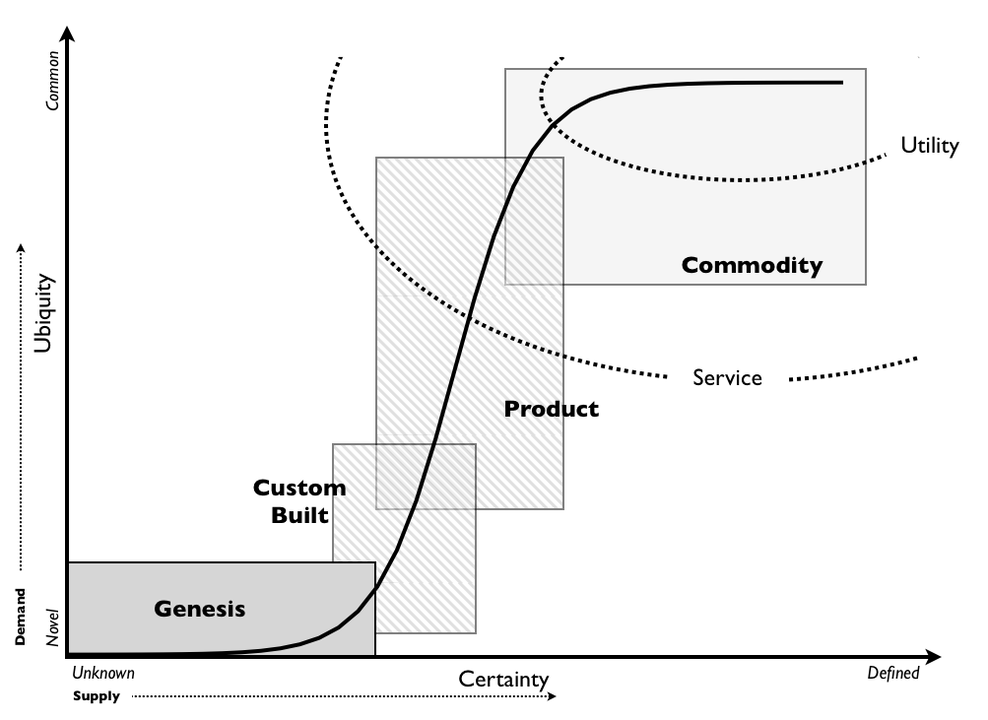

There is high demand for, but low understanding of digital transformation. This is evidenced by the high use of the term and the wide variety of meanings applied. We are far from 'Defined' (see above) yet demand is close to Common (on the Ubiquity axis). This suggests an urgent need to shift from hand-made solutions (Genesis) to take our clients toward greater certainty.

To do this we Productise as many of the capabilities that deliver emerging best practice as we can - ie we have to become expert in discovering emerging practices in complexity through repeatable and scalable ways of Probing, Sensing and Responding with end-user facing artefacts as rapidly as possible.

These ambiguity-handling activities respond to the need to move clients to greater certainty, enabling them to take advantage quickly as each practice emerges; productising the output at speed and achieving confidence (greater certainty) as each is defined.

As each new understanding of part of the complex emerges, this will drive value-building activities, creating higher-order outputs - just as productised nuts and bolts enable the building of higher order products when they replaced hand-made objects at the start of the industrial revolution.
 
The above slide illustrates some principles of action - mapping the amount of productisation vs customisation required in consulting activities across the project lifecycle.  Ambiguity is at its highest in the early steps.

Of course, how you act on the strategic imperatives I have outlined above will vary depending on your organisation's cultural, quality and profit goals. 

What is consistent is that different kinds of skills and ways of working will be a basic requirement of Consulting 2020 and beyond. For example:

PEOPLE
  • Divergent thinkers who seek to work at the speed of digital.
  • Those who have comfort with ambiguity- learned through experimentation.
  • Natural and continuous disruptors.
  • Less focused on analysis and more focused on evidence-through-testing to answer clear business questions
  • Those skilled in start-ups, experienced entrepreneurs.
WAYS OF WORKING

Processes and products focused on delivering emerging practice. eg:
  • Hypothesis generation/ideation.
  • Rapid, insight and value-led iterative prototyping of strategies as well as of products and services.
  • Tools and capabilities to prioritise and roadmap with an eye on the horizon for disruption.
  • Frameworks for PX in sustainable businesses.
  • Processes for the rapid productising (and scaling) of emergent practices.
Taken in total, this understanding and the action it requires of us, provides both the ambition and vision for Consulting for the next decade; its mission:
Create confidence in complexity for people, planet and profit by handling ambiguity and enabling sustainability.

Labels: , , , , , , , , , ,

Wednesday, October 31, 2018

Coding the economy to cut the high price of low cost

Photo by Ray Hennessey on Unsplash

The allocation of resources - and the cost of optimising that allocation - has always been humanity's most profound challenge. Artificial Intelligence may offer our best solution - but only if we are prepared to think globally.

Capital and the market model it sustains has been held up as our best bet for resource allocation for centutres. Yet capitalism and its governance are not necessary states by any means. They are emergent properties of the complex adaptive system we describe as the economy.

One transaction allocating value does not capitalism make. Multiple ones at scale can. Just as a molecule of water is not a wave, let alone a tidal force. These are emergent properties of complex adaptive systems.

The interactions within the system are what creates those emerging properties. Change those interactions and the properties change.

The best modifier we have had to date has been Government intervention - taxes, laws, welfare etc. But complex aqdaptive systems are notoriously difficult to tinker with. Think of the butterfly effect as applied to weather (another complex adaptive system).

So a Trump here or a Brexit there is going to have some impacts, but predicting exactly who, where and what feels the chill wind is a somewhat more exacting science than knowing that change will come.

As our economy has become more connected (and decentralised) it is becoming more anti-fragile. Make no mistake the economy will keep on functioning no matter what governments do. The question is can it be controlled somehow to ensure the emergent properties are desirable for humanity?

As we head towards quantum computing and ever more intelligent automation the point looms at which decisions to allocate resource will patently be better handled by machines.

Our machines will be better able to calculate the global economic costs of each transaction. They will factor for the environment as much as for human need. If we code that in.

But this is going to be a greater race for power than military applications of AI. Those who choose not to take part will be at significant compertitive disadvantage to rivals.

So the pressures to allocate to meet immediate human gratification will be huge. Only through global agreement on total costs will we give our children a chance.

Labels: , , , , , ,

Wednesday, September 10, 2008

How to avoid extinction in an evolving world

I saw Rory Brown tweet about journalist Hugo Dixon talking about the death spiral of newspapers today. It's a subject dear to my heart. Newspapers were where I started my career 21 years ago. I was trained for print.
But we've logged their decline on this blog and many others. Microsoft, for example, predicts their extinction within 20 years.

The newspaper industry made, in my view, two key errors.
1. It missed the quality opportunity.
2. It spurned the R&D advantage it had

Now these are very grave errors. But if you're not in the newspaper industry I'd advise against form of smugness. For there, but for the grace of etc etc... (image by colin purrington via flickr)

Newspapers had (perhaps still have) an opportunity to do what the gift economy of the net couldn't: Invest in quality.

Churning out the same press releases anyone can find repeated 1000+ times on the internet may be cheap but it's also self-destructive. If you can't beat the web on price, you can't beat it on relevance and you can't beat it on speed (and you can't) you'd better find something else to beat it on. Quality seems the only game left in town. The creation of the point-worthy.

The R&D advantage was spurned too. When the print barons had piles more cash than the gift economists of the likes of wikipedia, google, youtube et al, they could have invested to make the kind of structural change required to match the networked world.

Now, ever more fearful, they are reduced to picking through the wreckage and looking for further efficiencies.

They chose not to invest in survival strategies for a world of complex adaptive systems (such as the net, such as evolution) and instead persisted with the linear mass-efficiencies models which worked so well in a mass industrial age.

Ok, so newspapers are having it hard. What's that got to do with you (if you aren't a print journalist, for example)?

Well, I don't think all of the troubles newspapers are facing are caused by the medium.

Anything which seeks to mediate in a networked world faces the challenge of being worked around, that's for sure. That is the impact of group forming network theory in practice.

But perhaps of even more impact is the way traditional companies and corporations are responding to, or are able to respond to, the huge changes being wrought by the networked world.

The death spiral Hugo Dixon describes is that of a company managing efficiencies. This is the mass industrial response - the fnal phase of the S-curve seen in many businesses (as referred to by Professor Malcolm Mcdonald among others).

When you have run out of innovations you turn to the accountants. More and more effort is focused on saving, less and less on growth.

You save until you can no longer spend.

This applies to newspapers.

It may also apply to a business near you.

Labels: , , , , ,

Monday, August 18, 2008

The networked world can make brands more relevant than ever

Brands risk losing relevance in a networked world - if they continue to apply broadcast, one-size-fits-all thinking to it.
But, by listening, responding and adapting to its group-forming nature, brands can become more relevant than ever.

Chuffed to say the following slidedeck was selected to be featured on the slideshare homepage on Aug 19.


What the network (the internet) is for:
The internet is for forming groups.
The fact that people can use it to organise themselves around shared interests, passions and aims (communities of purpose) at next-to-no-cost, disrupts everything.
People can organise themselves to achieve what they want on a niched global scale.
This has world-changing implications for all forms of mediation - branding and brand messages included.

Three key disruptions:
  1. Who gets to create content (control messages)? Any and everyone.
  2. Who gets to distribute content (share messages)? Any and everyone
  3. Who gets to control the user experience? The user is the destination now. They control their own A-where-ever journey.
You can't target every community of purpose. They can.

This 10-slide deck explains how allowing messages to evolve is the most efficient way of transmission in the networked world - and the only way of reaching into the increasingly long tail. It is the right response to life in a complex adaptive system.

Without this reach your ability to achieve scale in the networked world relies wholly on one-size-fits-all quality. That's fine in broadcast mediums. But the network is not a broadcast medium. In networks, where communities of purpose form, relevance wins every time.


The timescale:
The great disruption of the internet has only just begun.
It is only with the arrival of social networks that the majority of users have been offered an easy-to-use interface for accessing the power of the network; group forming (with purpose) on a global scale. When an interface becomes ubiquitous, then significant change occurs. Cite: The telephone.

It is only three years since myspace first clocked more page impressions than google. It is only three years since YouTube started changing the way we think about television.
The great disruption of the internet started just three years ago. You ain't seen nothing yet!

Key Lessons


1. Listen:

Brands are what their users say they are.
Noah Brier's Brand Tags illustrates this in a so-funny-it-hurts (and not in a good) way. Check out your brand now at brandtags.net. There is a UK version too, but data is currently a little patchy. Make it richer, here.

Users tweet about coke, british airways, o2, macdonalds, or anything else you care to name. Search using your own terms at summize.com (twitter search)

Their conversations tell you not only what they think about your brands, but also how, where and when they use them and who they are using them with. They use them as the content that sparks their conversations.

The conversations are happening with or without your consent, on or off your own mediated forums, branded social networks and chat rooms, in every connection between every node. Where people are, they talk. And where they talk, they talk about you.

Some brands are making great use of the new social mediums. Zappos (an online shoe retailer in the US), for example. And David Armano at Logic + Emotion offers a useful reminder of how brands should approach social media (using twitter as his example).

You can't build communities or control the conversation. You can enable. Join them around their campfires. Be prepared to listen, then serve them with things that are useful - things they they will think are cool enough to pass on to others, who they think will think its cool, too. They are best placed to judge this. Not you.

You've got to be joking?
Look on the funny side. Think how jokes are adapted to be passed on. How do you select which gag to tell which person or gathering. How do you adapt it to suit. That adaption = adoption by the next community of purpose.

The business case
Since approximately 70% of purchase decisions are made based on friend's recommendations (according to Forrester) - you have to seriously consider focusing more of your spend on connecting where the conversations are happening and placing higher value on the conversations and the results of those conversations.

Radian6 among other sentiment trackers, can reveal how your brands are being talked about. That's the information gathering phase... But there is a tangible connection between trust and responsiveness, as Jeff Sonstein says.

2. Respond
In the networked world marketing isn't done to them, it's done by them. Think less about where the eyeballs are and more where the mouths and ears are. And think about joining their conversations in real time.

Real time captures the moment of inspiration. "I want to buy X". It is the essence of two of my more simple concepts, the Intention Economy. and Lean-To-Marketing.

Responses that work:

Widgets with personal outcomes.
Widgets that allow users to adapt them to better suit them to the community with whom they choose to share them next, are a brilliant fit with the networked world.

There are numerous examples. One of my favourites was Pampers US campaign last Christmas. It lowered technical barriers to allow any and everyone to mash up pictures of their own kids with a beautiful video and Silent Night message of Christmas peace. And that made it a widget with a personal outcome. Anyone who did it would want to share it with their close relatives, at least. And each of the receipients may like the idea sufficiently to adapt it to include their own children, and pass it on to the next adhoc community... and on it goes. Unfortunately it is no longer available here.

Others include the Simpsonizeme.com (can you see what they'd done there?) which turns your mugshot into a Simpsons version of yourself, to coincide with the movie release. That does live on, in association with BurgerKing.

In each case we create a version for ourselves to take on our journey with us. And in the process it becomes our message to share with our communities.

Mark Earls (author of Herd) suggests "give them something to do together".

The Cadbury's Gorilla's manifold reinterpretations on YouTube illustrate the power of this idea. And here's an important lesson, whether or not Cadbury wanted the network to take its idea and play with it and share it or not, that's exactly what happened. (hint, they aren't in control of the message. They never were).

You can tap into this.
There are three conditions required for a successful widget.
1. A willingness to relinquish control.
2. Toolkits users can play with.
3. Creative users.

We've clearly got creative users. We can make their lives easier by lowering the technical barriers (as Pampers did) and providing tool-kits to make co-creation easier (just as NiN have by providing tools on their website to allow fans to easily remix their work and share the results).

And since that which we create, we embrace, we're more likely to take on the role of marketer on behalf of what we have created, selecting the right communities of purpose to share the outcomes with.

2 & 3 are relatively easy. It's number 1 many struggle with. But without it you're left trying to control a message - trying to dictate where and when and how it will be delivered. And you're not very good at that - at least you're nowhere near as good as the people living in those communities.

This post How We Are Made Great discusses how individually we cannot hope to be in control of turning the flock, how important it is to take a human social approach to changing opinion or behaviour.

In this world even the role of links is challenged (as I discussed in Portability is the new Linkworthy)
They did a great job at discovering people through content.
But we're entering a world in which content is discovered through people.
Here being pointed at is less important than being taken with. Widgets are consumate taken-with enablers.

Going on the journey all brands must make if they are to adapt to survive in the networked world goes more than skin deep. It requires cultural shift, a cultural shift that makes the brand itself a better fit with the networked world. We are in transition - so broadcast models still have great value - but the speed of the transition becomes faster by the day.


Great examples of brands listening to and adapting to the networked world:
Zappos understand that customer service (human interaction) is everyone's responsibility.
Pampers makes your kids the stars Christmas campaign.
NiN make mash-ups easy and shareable.
Where are the Joneses takes Ford to new places.
The Simpsons/Burger King
Itsmy.com (their user-chooses-the-ad model leverages the social graph in a brilliantly simple way).
Spinvox for listening and responding. (and that reminds me of qik's lean-too marketing)
Carphone Warehouse listens... (example of inevitable two-speed culture in a giant?)

Your further examples welcome. Post links in the comments below and I'll add them to the list as they come in.

Labels: , , , ,

Tuesday, August 5, 2008

How to adapt to survive the 21st century

I believe in evolution. That is, I believe in complex adaptive systems which use relatively simple rules to create immensely complex outcomes - such as the weather, the economy, ideas, messages, the internet, ourselves, and life on Earth. They do this by a process of iteration, selection and amplification.

I have discussed (The Perfect Storm: A Fourth Element) how I believe it is no coincidence that the fastest growing company in history (google) exists at the same time as the internet: two complex adaptive systems are coming together (the economy and the internet) to fan the flames.
We are looking ahead into a golden age. And you will be part of it; If you adapt to survive.

One outcome of evolution is that there are always casualties - things that get dampened out of existence rather than amplified to success. Don't be a diplodocus. (image shared via flickr by cpurrin1)

I have a handful of simple rules for success for individuals driven by the idea that in order to adapt to survive in any given environment the first and primary requisite is that you are living in that environment (told you these rules were simple...)

So I always suggest:

Write a blog: Discover how easy it is to be a publisher, how easy it is to create and share content, how easy it is to form groups of shared purpose in networks of trust, how easy it is to find relevant content and for relevant people to find you. More.

Build a widget: You have to start by trying to guess who might choose to share your widget or be enthused or impressed enough to pass it on - which raises a whole bag of questions. More. Discover not only that we are all publishers now, we all distributors, too - and all of us are advertisers.

To which I'll add:
Join a social network: Discover the easy-to-use tools that are making group-forming ubiquitous (more on why this is so critical here).

What tips do you have? What other advice for individuals and groups do you have to help them adapt to survive in the networked world as it comes to dominate the 21st century?

Labels: , , , ,