Reframing consulting for the next decade
Consulting's core activities are being outmoded by the rise of digital and the demand for digital transformation.
An hypothesis: Clients need consulting to be reconfigured to prioritise and master:
- Handling ambiguity
- Enabling sustainability
DIGITAL HAS DRIVEN THE NEED TO MASTER COMPLEXITY

Customer Experience drove the last 20 years of business success. Digital Transformation consulting has recognised this with the culture-change, processes and platforms to serve great CX.
Sustainable success in the next 20 years demands we add a new dimension to Experience. To great CX, (and the accompanying Employee Experience and Workplace Experience longevity demands) we must add PX - the elevation of the relationship with the planet to the level of the relationship with the customer.

Consulting has, for the most part, operated in the ‘good practice’ area of the ‘Complicated’ upper right quadrant shown above. This is the realm of: Sense - Analyse - Respond (in order to decide/act). The connections between cause and effect are complicated but knowable. Experience and expertise help discern those connections. And that has been the role of the consultant - the subject matter expert.
In many 'Systems Integrators', some of what also gets called consulting has has even fallen into the ‘bring the best practice’ area of the Obvious (see above). Here connections between cause and effect are well known and clearly visible. You just need to Sense-Categorize-Respond (see typical Business Analysis and vendor assessment work). The latter is commoditised, the former is outmoded by today’s digital requirements.
In many 'Systems Integrators', some of what also gets called consulting has has even fallen into the ‘bring the best practice’ area of the Obvious (see above). Here connections between cause and effect are well known and clearly visible. You just need to Sense-Categorize-Respond (see typical Business Analysis and vendor assessment work). The latter is commoditised, the former is outmoded by today’s digital requirements.
Now the need is to handle the ambiguity of cause and effect experienced in Complex environments.
In complexity the connections between cause and effect are unknown. This is the realm of experiment, trying, new ways, understanding the connections by finding them. That's not analysis. No expert has a head start. The expertise required is in reading emergence (ie making sense) and in responding (ie getting on and doing as the best way of validating the emerging value. We can and should become expert in that.
Today's problem statements are far less of the 'How can I best respond to what I know?' variety and more of the 'How can I better understand what it is?' The latter can help us get to the former, but leaping straight to the former is an error in complex environments.
So consulting has to change what it does and how it does it, to:
1. Deal with the ambiguous, complex requirements of the digital world.
So consulting has to change what it does and how it does it, to:
1. Deal with the ambiguous, complex requirements of the digital world.
And that's not all...
Customer Experience has driven digital transformation to date - now there is a new dimension to CX to consider - Planet Experience (PX).
A NEW DIMENSION OF EXPERIENCE
Customer Experience drove the last 20 years of business success. Digital Transformation consulting has recognised this with the culture-change, processes and platforms to serve great CX.
Sustainable success in the next 20 years demands we add a new dimension to Experience. To great CX, (and the accompanying Employee Experience and Workplace Experience longevity demands) we must add PX - the elevation of the relationship with the planet to the level of the relationship with the customer.
I have written at length on #px in recent posts and shared initial frameworks for value generation and org maturity assessment. Core to this is the understanding that customers, employees and the culture of successful orgs over the next 20 years will demand we understand and create value for the planet just as much as we have the customer in the previous 20 years.
And just as those organisations that were built to partner the customer from the word-go ended up out-competing incumbents when they reached the scale of their older rivals, so, my hypothesis suggests, those organisations that are built to partner the planet will do so to the benefit of people and profit, too.
Example frameworks include the following:

And:

Given the PX imperative, consulting has to change what it does and how it does it, to:
Deal with the ambiguous, complex requirements of the digital world.
&
Handle the rising prioritisation of concerns for the planet.
Situational analysis (with the aid of Wardley Maps) shows us there is an increasing need to make sense at scale - revealing the task of the 21st Century consultant is to create confidence (on the certainty axis below) in complexity.
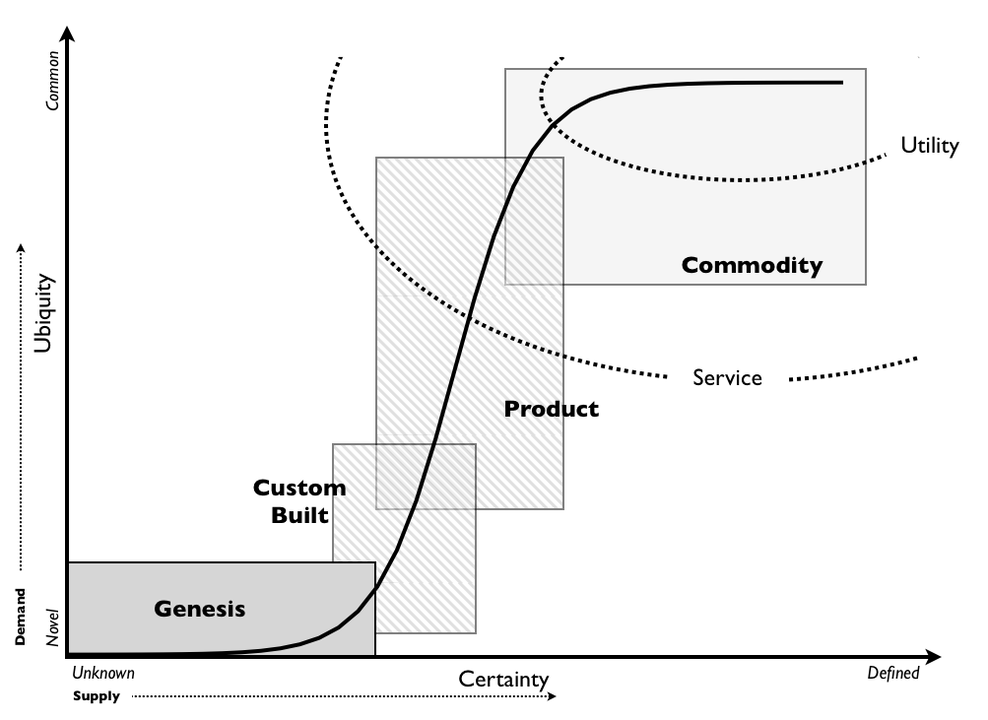
To do this we Productise as many of the capabilities that deliver emerging best practice as we can - ie we have to become expert in discovering emerging practices in complexity through repeatable and scalable ways of Probing, Sensing and Responding with end-user facing artefacts as rapidly as possible.
These ambiguity-handling activities respond to the need to move clients to greater certainty, enabling them to take advantage quickly as each practice emerges; productising the output at speed and achieving confidence (greater certainty) as each is defined.
As each new understanding of part of the complex emerges, this will drive value-building activities, creating higher-order outputs - just as productised nuts and bolts enable the building of higher order products when they replaced hand-made objects at the start of the industrial revolution.

Of course, how you act on the strategic imperatives I have outlined above will vary depending on your organisation's cultural, quality and profit goals.
What is consistent is that different kinds of skills and ways of working will be a basic requirement of Consulting 2020 and beyond. For example:
PEOPLE
- Divergent thinkers who seek to work at the speed of digital.
- Those who have comfort with ambiguity- learned through experimentation.
- Natural and continuous disruptors.
- Less focused on analysis and more focused on evidence-through-testing to answer clear business questions
- Those skilled in start-ups, experienced entrepreneurs.
WAYS OF WORKING
Processes and products focused on delivering emerging practice. eg:
- Hypothesis generation/ideation.
- Rapid, insight and value-led iterative prototyping of strategies as well as of products and services.
- Tools and capabilities to prioritise and roadmap with an eye on the horizon for disruption.
- Frameworks for PX in sustainable businesses.
- Processes for the rapid productising (and scaling) of emergent practices.
Taken in total, this understanding and the action it requires of us, provides both the ambition and vision for Consulting for the next decade; its mission:
Create confidence in complexity for people, planet and profit by handling ambiguity and enabling sustainability.
Labels: #px, ambiguity, complex adaptive systems, complexity, consulting, customer as partner, cynefin, digital transformation, Planet Experience, PX, wardley maps
posted by ADMIN @ February 27, 2020
0 Comments


