What are the biggest challenges for PR in social media?
What are the biggest challenges for PR in social media? That's the question Jamie Burke, founder of the P2PR Ning Community put to me last week. The video below has my off-the-cuff response. Love to hear yours.
For the sake of transparency, Jamie and I work together at Brando-Digital, where we talk about this kind of stuff all day...
I've been thinking about how messages are spread in the networked world, how our connectivity, our group-forming nature, finds ways around control and mediation of all forms. And how going with this flow rather than working against it is more likely to result in 'your' message (it becomes theirs the moment you let go) being passed on.
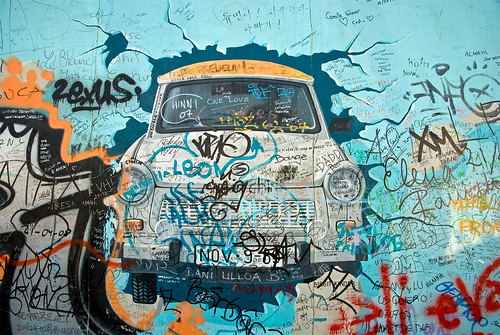
This doesn't just apply to messages, of course, but to anything that becomes over processed. Where the intention is control, the result is often the opposite. (image via flickr by Mike McHolm)
Those who feel confined, restricted, halted by those controls and structures simply work around them. There are lessons for companies, government, education and more in this.
Anyone who has adapted to living in the network won't stop doing what they want to do, they just won't do it with you.
Should bands sue record labels over threat to ban fans?
This is such typical centralised, broadcast thinking. Just exactly what do they think they can control? The record industry has struck a deal with the six major UK ISPs and the Government to 'deal with' people who illegally share music*.
How do they propose to do this? Well, they'll send us a stern letter (anyone else see the irony in choosing the post as a delivery mechanism rather than an IM or an email?). Er....and then they'll think about what to do next... Right.
There are a few problems here. I don't have enough life to detail them all, but let's describe the biggies.
1. Nobody owns the internet - least of all the six major UK ISPs. They have no control over what is done on it or by whom or how one node or person connects to another. Their only control is to charge admission. They aren't the only ones to supply access. Others will see a competitive advantage in refusing an invite to this Government-hosted record industry party. Beware the backlash big fellas!
2. Haven't the record companies heard of the because effect?Prince has, Radiohead have, NineInchNails have, and recently (free cd on the Mail on Sunday just before the release of a not free CD) David Bowie has. If you can't make money with content, you can because of it (eg google vs yahoo!). Is the Guardian about to send me a letter insisting I cease and desist from linking to its website because of the link I shared at the top of this post? No it expects the attention I have given it to create value (see also point 4!). Get it?
3. This is a slippery slope. If the Government is so keen to encourage complicity with national laws in respect of music downloads, why not on porn? What if it gets a taste for this control lark? Would anyone use the Government-approved internet?
4. *Thou shalt not promote/recommend to your friends (leveraging your own social graph as the perfect distribution method) or otherwise solicit the sales of our product... is not something I would expect the promoters of artists (that's you, record companies) to demand of my fans.
If I was in a band I'd seriously consider sueing!
The internet changes everything. You cannot expect to impose old ideas of business as usual. As Clay explains (via Alan) below. Buy Clay's book. It's great. Mind you, so is Alan's.