Wednesday, April 15, 2020

What success looks like in the post Covid-19 reality

Two very rapid shocks to our system are happening within six months. Two Black Swans. The first - the emotional, economic and health trauma of COVID-19, we didn't see coming. The second, the COVID-19 economic Bounce Back - that we can.
Best predictions are that the UK economy will contract by 35% this quarter but bounce back (perhaps we should call it Boom Back) to plus 30% in the following quarter. That positive shock is just as hard for organisations to handle as the negative one - think of the impact on supply chains, labour demand, infrastructure use, retail demand, capital and cash flow requirements etc. The bounce back looks like being as short and as sharp as the crash we have experienced. An extreme impact black swan in the other direction. And one you KNOW is coming.
The expectation is that after the bounce back there will be a resettlement of the economy to a new stasis with a smaller GDP on a global scale. I will return to this new stasis shortly.
But first a note on the decisions facing us now. The greatest threat to your organisation right now is in choosing the 'hunker down' option. This may appear counter-intuitive. But in hunkering down (ie reduce costs as much as possible, try to get by with the trickle of business you sustain, scale back ambition and initiatives, return to basics, halt investment in the new etc etc... you've been in those meetings) you make your organisation more fragile to the next shock just as the second black swan looms. You will not be prepared for the shock of the upturn.
The net result is you are choosing to be a victim of the first crash, taking all of the hit with no levers available to you to take advantage of the bounce back. Lose-Lose when you could have at least come out evens with a Lose-Win response.

Returning now to the new, post Boom-Back stasis, the new normal if you will.
I wrote recently about The Second Order Consequences of COVID-19, which I urge you also to consider in your preparations for life after the Boom-Back. In it I start to unpack the disruption that will follow.

To those I would like to add a handful more:
1. Digital magicians have had their day. The mystery of digital is rapidly dissipating as even the most Luddite leader is forced to learn how to DIY digital, to maintain any semblance of control over their business and people. The thing they thought they needed an 'expert' for, they have (and not through choice) found they really don't. This means:
2. Digital Transformation will have to go well beyond the tools and training. Everyone and their aged mother now 'gets' digital. The dads are discovering they can dance at this wedding and they don't care who is watching. So digital transformation must now be more about business models not simply the roll out of Teams. That stuff was always IT. Digital is new ways of working and new ways of doing business.
3. High Street Honeymoon: Pop-up shops. This will be a short term boom. The High Streets will be rammed for while but fall back to a-bit-less-than-now shortly after. So, pop-up shops and everything that supports that will explode. Expect markets to get a new lease of life.
4. Value your people people: The first meeting may be the only one in a travel-budget constrained world. Those who are excellent at building rapport will be at an advantage in rapidly building relationships that can continue online.

I want to build on these now to identify the a broader impact on the skills we value in business and the ambitions we have for organisations. The most important may be an end to the idolising of growth.

Grow Or Die, is dead.
The double black swan shock we are going through, followed by the new globally reduced GDP in the mid-term at least, offers us the opportunity to ask what success now looks like.
Are you a successful nation, company, individual or leader if you earn less this year than last?
We are going to have to get comfortable with answering Yes to that question. At the heart of this challenge is the Grow Or Die mythology.
Today we understand that myth is leading us toward environmental collapse. Grow And Die.
Success in a world of less is more aligned to human happiness. After all, our economy was never meant to simply generate a GDP figure. What should it be for? Perhaps to deliver happiness.
Doughnut Economics offers us some clues: "The framework was proposed to regard the performance of an economy by the extent to which the needs of people are met without overshooting Earth's ecological ceiling." In this model the job of the economy is to generate a safe and just space for humanity to thrive.
If that is the job of the economy (rather than to deliver growing GDP) then what is the job of a business or organisation within that economy?
These questions lead me towards the triple-bottom-line thinking captured in the Planet Experience frameworks I have been developing - and an increasing demand for ecologically sound business and products.
In Planet Experience we have a way of being successful without costing the earth, without taking more than we need, and in line with the needs of humanity.
Being successful in 2021 will be all about how well you adapt to thrive within the constraints of a clearly constrained environment.
Empathy is now a key survival skill where ruthlessness was once lauded. Co-operation and collaboration are back.
And that, already, makes me happy.

Photo by Larm Rmah on Unsplash


Labels: , ,

Monday, April 6, 2020

2nd Order Consequences of COVID-19


The Great Interruption of 2020 will lead to the Great Disruption of 2021. And this will be a disruption unique since World War II - one which took everyone by surprise and is pretty much evenly distributed in a very short period.
Tech disruptions tend to impact over 20 year cycles. This is something different. COVID-19 is driving massive habit change and with it the potential to have deep impact on society - potentially culture-changing impact. We are seeing the initial impact immediately.
Again, uniquely, we have the Great Pause we are all being forced to contemplate, to prepare for what comes next.
There are the first order consequences we see reported on our evening news. The economic shut-down, the school closures, the strain on supply chains.
And then there are the second and third order to come.

Consider:
1. Demographics: Beyond the first order consequence of the death of one-in-ten aged over 80 (which is about in line with deaths from all causes for the over 80s in a typical year), the bigger impact will be in a slump in pregnancy rates. Since COVID-19 was identified as a risk to pregnant mothers, sales of birth control went through the roof. So we can expect a 3-4 month birth lull in 9-12 months time. That gap will be present as it hits the health service, then nursery education age, school age, college age, and entering the workplace in 18-21 years time. That's a lot of flux for all our institutions to handle. The lull is likely to be followed by a boom.
2. Food: Yep, in lock down we think about it a lot. We make meal plans. We start to value 'fresh', we become very conscious of waste, we find time to make from scratch - all the things the convenience (read Easy) generation(s) have bypassed for 20 years. The first order consequence of disruptions to supply lead to second order consequences of increased valuation of the food we do have. New habits forming now could see a mid-term negative impact on restaurants, fast food outlets, convenience food manufacturers... and a positive impact on organic, locally-sourced, fresh suppliers. Reduced consumption (via reduction of waste) is a likely second order consequence across the board.
3. Education: Lessons, quite literally, are being learned about digital. First educators are getting a rapid education in virtual lessons. This has benefits for meeting individual learning styles, aligning with need in more individual ways vs time of day you find best for learning, pace at which you prefer to learn etc. Just as digital has generated the opportunity to move away from treating customers in a one-size-fits-all way, so it reveals an opportunity for segmenting and personalising education which could rapidly accelerate its outcomes for every individual. And beyond that, digital means expanding the capacity of an individual teacher or institution such that we can now teach the world. There's a UN Sustainable Development Goal on the way to being met, right there.
4. Politics: The emergence of an instant Technocracy (rule by unelected experts) is one we seem quite comfortable with. Our politicians right now (as seen from the UK) are pretty much mouth-pieces for their experts - the Chief Medical Officer and the Chief Science Officer bringing a level of evidence-based rigour to decision-making that our very generalist politicians are quick to defer to. Will this be forgotten when our experts on the economy make comment on issues (such as) Brexit in the future? That remains to be seen but trust is science is (outside of the flat-earthers, anti-vaxxers and 5G fallacy peddlars) at an all time high. This bodes well for a shift in the political landscape toward one where the focus is less on what plays well to the gallery (the populist agenda) and more on a test-and-learn, more honest, approach to dealing with the ambiguity of the economy. Less opinions - more evidence. We can hope.
5. Travel. When this lock down is over I suspect a lot of folk will want to travel for pleasure. But from a business point of view, we have learned a lot about how digital really can replace jumping on a plane. Senior execs have been given an accelerated learning and that has positive impacts for their bottom line. Expect travel budgets to be slashed at the very least - with all the second order consequences for airlines, airports, hotels, car rental, conference venues etc.
6. Antifragility - If that sounds like a made up word, let's talk about business resilience instead (though if you are familiar with antifragility, you will appreciate the difference). The bottom line is COVID-19 has revealed to us again how inefficient being too optimised is over anything more than a short-term period. And we cannot predict, with any certainty worth having, how long that short-term may last. Systems - from supply chains, to ways of working, to value proposition have been revealed to be too inflexible to cope with shock. The first order consequence of that is shattered businesses with the shattered lives they leave in their wake. Second order - businesses that survive will have already made themselves anti-fragile in several ways and those that build after will learn from them. The whole notion of leveraging, fantasy multipliers, business plans built on same-happening-next-year-but-a-bit-more must be swept away. Second order may be in the personal realm - we may have just created a generation of savers, folk who will try to build some anti-fragility into their own finances and ways of living. My guess is this will result in reduced consumption as people seek to live lives in reduced debt, building some cash reserves, fore-going the next new car, TV, phone, foreign holiday. Consuming less and savouring more.

All these consequences of COVID-19 (and I'm sure you can think of many others) accelerate the demand for what I had already identified as twin increasing trends:
  1. Ways of dealing with the ambiguous, complex requirements of the digital world
  2. Ways of handling the rising prioritisation of concerns for the planet.
The first because we face such a period of disruption in which we may see what is hitting us but we lack clarity as to the connections between cause and effect. We have to probe-sense-respond our way through this to develop the most appropriate digital responses.
The second because we have seen we CAN make a difference (in those pollution-falls stories you will have seen). We all have a renewed appreciation of the simple pleasure of time spent in nature. We are all learning the importance of reducing waste. And we are all appreciating more the damaging impact of unchecked consumption on our own lives and on the fragility of the systems, economic and natural, we depend on.

Change is coming. You have time to act. Don't waste the opportunity.


Photo by Melissa Askew on Unsplash

Labels: , , , , , , ,

Wednesday, March 18, 2020

The web gives us a critical advantage over this virus

As we come to terms with the news that UK schools are about to close for what could be six months, I find myself reflecting on how lucky we are.
Imagine if this had happened before the mass adoption of the web?

When I was at school there was no internet. A pc was a rarity. Mobile phones unheard of.
I would not have been able to order what I needed online - and there certainly was no opportunity to experience e-learning, virtual classrooms or any of the other digital innovations education has been dancing with, but will now have to adopt on a mass and 'business-as-usual' scale. Imagine facing the next six months without any of that.

Of course, the same is true of business.

The web allows us to continue to trade, to continue to meet and do deals, to collaborate on ideas, concepts, prototypes, launch strategies and projects of all kinds.
We are exceptionally lucky that Covid19 comes at a time when we have the technology to physically self-isolate WHILE socially connecting. This is the only time in history that has been possible.
The web has given us a critical advantage vs this virus.
We can continue pretty much every aspect of trade and education. We can maintain our economic progress. We can do it while improving our relationship with our planet.

All  we have to do is get over the shock and get used to a few new tools.

We can do this.

Labels: , , , , ,

Tuesday, March 17, 2020

Covid-19: You can only predict with the data you have. Scary numbers in context

Like so many commenting on this Covid19 crisis - I'm no expert. I just connect the dots to try to understand - just as I do with anything else I experience.

So here's my guess on what the Government is up to:

1. They were always planning to put the vulnerable in a long period of isolation. The bet was that in isolation very few (comparatively) would succumb. They were expecting the 10s of thousands of deaths number they now hope to manage us towards.

2. Acting in this way early enough would allow the wider society to continue to function and - crucially - the NHS to cope.

They assumed that those requiring hospital beds would broadly be in that vulnerable group with limited exposure. But lots of younger folk need some care. They survive - but they need NHS resources. That's what the data shows from Lombardy - and that creates the crisis point for the NHS.

I think the tipping point moment for the Government was when they recognised (only this weekend) that there were likely to be up to half a million cases in the UK already - not the few thousand detected. In that scenario it is highly likely that those now being asked to isolate for months include large numbers who have already come into contact with the virus.

That could result in significantly higher numbers of deaths than an earlier invocation of isolation for the vulnerable would have caused.

If you take a (broadly) mid-point mortality rate between the Chinese and Italian experiences you end up with 100,000s of thousands dieing in the UK. This sounds scary big but remember, 550,000 people die in the UK every year and many of those this virus will be accountable for are substitutional rather than additional (ie folk who may well have died in the same 12 month period).

To provide some further context, if 100,000 people do die in the UK - that's one in 600. Alcohol or drugs kills 1 in 34 , heart disease 1 in 4. And the average American has a 1 in 77 chance of being killed by firearms.

Had we moved to isolate the vulnerable earlier, the period of social distancing for the rest of us that is now required could have been significantly shortened. But you can only predict with the data you have. And that 500,000-cases-in-the-uk guestimate is very new.

My guess is now that restrictions will only be lifted once the vulnerable are secured and the hospitalisation-rate among them calculated.

The Great Pause has begun.

Labels: , , , , , , , , , ,

Saturday, March 14, 2020

The business logic of Planet Experience


There has never been a better time to shift the way you create value to elevate the planet's experience to the level of the customer's experience (Planet Experience). 

Analysis by PwC in 2018 showed while 72% of companies mention the UN's Sustainable Development Goals (SDGs) in their annual reporting, only 27% include them in their business strategy. What that says is that they value sustainability - but struggle to make it part of their business as usual.

In Planet Experience, we have a framework for operationalising sustainability and placing it at the heart of value generation and business strategy.

Planet Experience makes for a better business model. Costs fall, innovation drives increased benefits.

1. In acting fast - being proactive - you gain market leadership and get ahead of legislation. 
2. You attract and retain customers, talent, investment. 
3. Drive creative innovation. 
4. Reduce risk to supply chain.
5. Cut energy costs.
6. Cut raw materials costs.
7. Cut water costs. 
8. Cut waste disposal costs. 
9. Savings fund transformation costs. 
10. Sustains the eco-system in which you wish to seek to continue to generate profits. 

Evidence? Take a look at the Ray Andersen TedTalk below. 
Now you are ready to act - get in touch. First hour free 1-2-1 consultancy via video link until the end of April.

Photo by Lukas Blazek on Unsplash

Labels: , , , , ,

Thursday, February 27, 2020

Reframing consulting for the next decade

Consulting's core activities are being outmoded by the rise of digital and the demand for digital transformation.

An hypothesis: Clients need consulting to be reconfigured to prioritise and master:
  • Handling ambiguity
  • Enabling sustainability
To illustrate why I believe these are the fundamentals of successful consulting in the next 20 years, I am going to (first) reference Dave Snowden's Cynefin framework - a conceptual framework to support decision making. The following illustration is from Dave's Cognitive Edge site. 

DIGITAL HAS DRIVEN THE NEED TO MASTER COMPLEXITY

Consulting has, for the most part, operated in the ‘good practice’ area of the ‘Complicated’ upper right quadrant shown above. This is the realm of: Sense - Analyse - Respond  (in order to decide/act). The connections between cause and effect are complicated but knowable. Experience and expertise help discern those connections. And that has been the role of the consultant - the subject matter expert.

In many 'Systems Integrators', some of what also gets called consulting has has even fallen into the ‘bring the best practice’ area of the Obvious (see above). Here connections between cause and effect are well known and clearly visible. You just need to Sense-Categorize-Respond (see typical Business Analysis and vendor assessment work). The latter is commoditised, the former is outmoded by today’s digital requirements. 

Now the need is to handle the ambiguity of cause and effect experienced in Complex environments.

In complexity the connections between cause and effect are unknown. This is the realm of experiment, trying, new ways, understanding the connections by finding them. That's not analysis. No expert has a head start. The expertise required is in reading emergence (ie making sense) and in responding (ie getting on and doing as the best way of validating the emerging value. We can and should become expert in that.

Today's problem statements are far less of the 'How can I best respond to what I know?' variety and more of the 'How can I better understand what it is?' The latter can help us get to the former, but leaping straight to the former is an error in complex environments.

So consulting has to change what it does and how it does it, to:

1. Deal with the ambiguous, complex requirements of the digital world.

And that's not all...

Customer Experience has driven digital transformation to date - now there is a new dimension to CX to consider - Planet Experience (PX).

A NEW DIMENSION OF EXPERIENCE

Customer Experience drove the last 20 years of business success. Digital Transformation consulting has recognised this with the culture-change, processes and platforms to serve great CX.

Sustainable success in the next 20 years demands we add a new dimension to Experience. To great CX, (and the accompanying Employee Experience and Workplace Experience longevity demands) we must add PX - the elevation of the relationship with the planet to the level of the relationship with the customer.

I have written at length on #px in recent posts and shared initial frameworks for value generation and org maturity assessment. Core to this is the understanding that customers, employees and the culture of successful orgs over the next 20 years will demand we understand and create value for the planet just as much as we have the customer in the previous 20 years.

And just as those organisations that were built to partner the customer from the word-go ended up out-competing incumbents when they reached the scale of their older rivals, so, my hypothesis suggests, those organisations that are built to partner the planet will do so to the benefit of people and profit, too.

Example frameworks include the following:
And:
Given the PX imperative, consulting has to change what it does and how it does it, to:


Deal with the ambiguous, complex requirements of the digital world.

&

Handle the rising prioritisation of concerns for the planet.

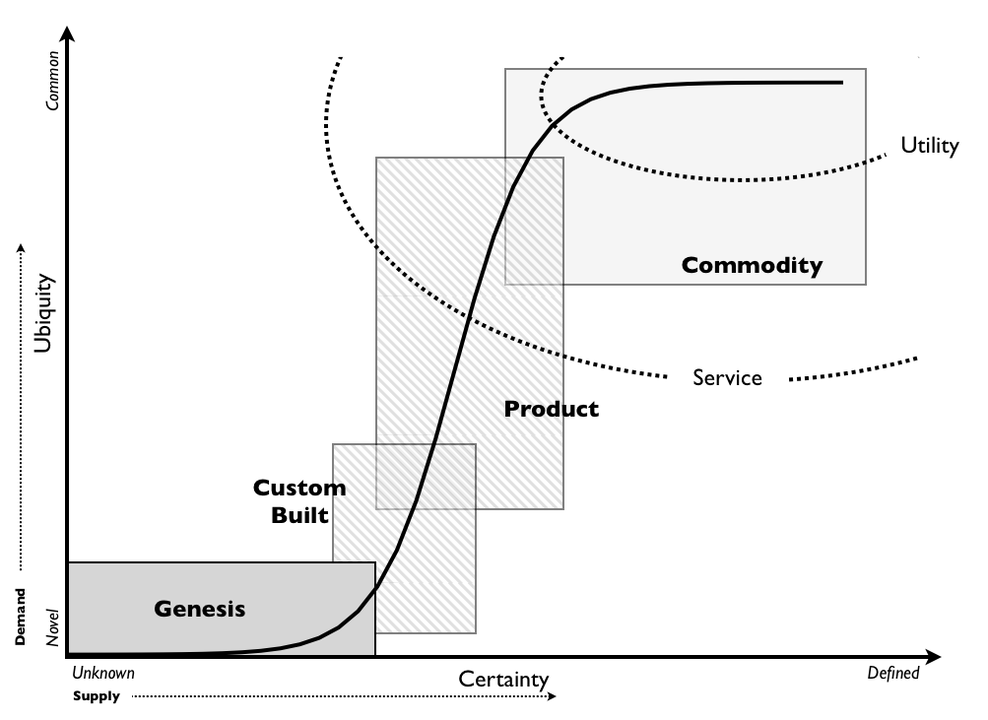
Situational analysis (with the aid of Wardley Maps) shows us there is an increasing need to make sense at scale - revealing the task of the 21st Century consultant is to create confidence (on the certainty axis below) in complexity.


There is high demand for, but low understanding of digital transformation. This is evidenced by the high use of the term and the wide variety of meanings applied. We are far from 'Defined' (see above) yet demand is close to Common (on the Ubiquity axis). This suggests an urgent need to shift from hand-made solutions (Genesis) to take our clients toward greater certainty.

To do this we Productise as many of the capabilities that deliver emerging best practice as we can - ie we have to become expert in discovering emerging practices in complexity through repeatable and scalable ways of Probing, Sensing and Responding with end-user facing artefacts as rapidly as possible.

These ambiguity-handling activities respond to the need to move clients to greater certainty, enabling them to take advantage quickly as each practice emerges; productising the output at speed and achieving confidence (greater certainty) as each is defined.

As each new understanding of part of the complex emerges, this will drive value-building activities, creating higher-order outputs - just as productised nuts and bolts enable the building of higher order products when they replaced hand-made objects at the start of the industrial revolution.
 
The above slide illustrates some principles of action - mapping the amount of productisation vs customisation required in consulting activities across the project lifecycle.  Ambiguity is at its highest in the early steps.

Of course, how you act on the strategic imperatives I have outlined above will vary depending on your organisation's cultural, quality and profit goals. 

What is consistent is that different kinds of skills and ways of working will be a basic requirement of Consulting 2020 and beyond. For example:

PEOPLE
  • Divergent thinkers who seek to work at the speed of digital.
  • Those who have comfort with ambiguity- learned through experimentation.
  • Natural and continuous disruptors.
  • Less focused on analysis and more focused on evidence-through-testing to answer clear business questions
  • Those skilled in start-ups, experienced entrepreneurs.
WAYS OF WORKING

Processes and products focused on delivering emerging practice. eg:
  • Hypothesis generation/ideation.
  • Rapid, insight and value-led iterative prototyping of strategies as well as of products and services.
  • Tools and capabilities to prioritise and roadmap with an eye on the horizon for disruption.
  • Frameworks for PX in sustainable businesses.
  • Processes for the rapid productising (and scaling) of emergent practices.
Taken in total, this understanding and the action it requires of us, provides both the ambition and vision for Consulting for the next decade; its mission:
Create confidence in complexity for people, planet and profit by handling ambiguity and enabling sustainability.

Labels: , , , , , , , , , ,

Saturday, February 15, 2020

Sustainable value propositions demand the integration of PX

Click to enlarge. Feel free to download and share.
Treating the planet with the respect we have come to understand must be accorded to our customers is not only a 'nice to have' - a box to tick in the latest ESG commitment or vision statement - it is a business imperative in the customer relationships of the next 20 years.

Just as great Customer Experience treats the customer as your partner in a relationship of mutual benefit, so Planet Experience elevates the relationship you have with the planet as one of mutual benefit. The purpose of great customer experience is to reduce the cost of customer acquisition (through recommendation, retention, brand extension cross-sale, upsale etc). It ultimately generates a relationship of trust which is the key ingredient in increased Lifetime Value (LTV).

Planet Experience offers a way for us to integrate the increasing concern your customer has for their planet. The planet can't trust you. Your customer can. But unless you integrate PX, they will see you as the enemy - the exploiter of the thing on which their life -and that of their children - depends.

That is a very powerful motivator. And one you should be integrating into your relationship with them right now.

I have shared frameworks to approach this in previous posts. Today I share a simple way to get started on this with Customer Value Propositions (see diagram). We must ensure PX is one of the key constituents.

Customers know the high price of low cost. It's up to you to demonstrate that when they trade with you there is not just reduced damage to the environment vs alternatives. You need to construct value propositions which call out the benefit they deliver for PX as much as they benefit they deliver for the customer.

Good luck - you've got the whole world in your hands.


Labels: , , , , ,

Wednesday, February 5, 2020

Your customers are the voice of the planet

Does the planet get to make choices in the way that customers do? When a customer feels they are being exploited they can adapt, reject or seek better.
What can the planet do? And what's the role of the customer in generating positive Planet Experience?


Labels:

Tuesday, February 4, 2020

Planet Experience (PX) won't win alone

Friday, January 31, 2020

Getting started on your PX transformation

It's important to recognise where you start from - and which direction you need to head in - when you are going on a journey. The journey to generating a great Planet Experience is no different.
So here's one way of considering your start-point and what good might look like on your organisation's route to a better, more sustainable partnership with your planet.
Consider this (above) alongside the high-level designs I have previously shared:
First (immediately below), the need ensure all the dimensions of experience are considered - PX is now ONE of the experiences you should design for - alongside Customer Experience, Employee Experience and Workplace Experience. A great PX alone is not the recipe for the next 20 years of success - it must be combined with equally great CX and - in any kind of organisation at scale - purposefully designed and aligned EX and WX.
And finally, a guide to generating those Experience-First propositions on which the org stands or falls. (below).
Feel free to explore, reconfigure and reshare!
And if you have a challenge you would like to explore solutions to using these approaches - please get in touch.

Labels: ,

Thursday, January 30, 2020

Introducing Planet Experience


Labels:

Monday, January 27, 2020

No Planet B - so we need Planet X

There's no Planet B - but there is Planet X. Planet Experience is the framework through which we can help make our organisations ones we can all live with; as customers, as employees and as participants in a biosphere we all rely on.

In recent and previous posts I have outlined the value of PX as the new business superpower - shaping our overall experience as potential and repeat customers (Customer Experience [CX]), as potential and continuing employees (Employee Experience [EX]), and in shaping the working culture (Workplace Experience [WX]).

PX elevates the status of the planet in our sustainable success - just as CX elevated the status of customers. No longer is the planet something to exploit, it is something to build a relationship of mutual benefit with. Through the PX filter it is something to purposefully design a relationship of mutual benefit with.

I believe this is important because:

1. It is business which can have most impact - since it is business which drives consumption.
2. Increasing transparency is revealing the impact of exploitation; of planet and people.
3. Customers are increasingly coming to care. The web has revealed our connectedness. We want our experience to be great but only if the cost of delivering it is, literally, one we can live with. I get that this is far from the case for all people in all cases - but the number it is true for is rising, and they carry a large amount of economic power.

Those that dismiss point 3 may suppose that the world is not changing around them - that the reality of climate change, reduced biodiversity, water scarcity, dwindling icecaps can be ignored with little impact on how they do business. The same mindset leads to relationships of abuse with customers, employees and society at large. And we now have increasing evidence that does not lead to economic success or business longevity. Ignore PX and you'll be revealing a lot about your opinion of your customers and employees, too.

But when all is said and done, PX is just the latest (but essential to acknowledge) expression of the long-known business fact that building relationships of benefit is the key to sustainable success. This time the planet needs to benefit, too.

I'm making my thinking on this as open as possible, deliberately. I want others to pick it up, fill the gaps, improve on it, share those improvements - for the benefit of us all.

It's too important for IP. What can you share?

Labels: , , , , , ,

Friday, January 24, 2020

Planet Experience - the next business superpower

The winners of the last start-up revolution achieved their success by focusing on experiences.
Their continuing success has built on designing to deliver great customer experiences, expanding, as they have expanded, to also deliver great employee and workplace experiences.

To deliver these require different priorities in everything from ops to marcomms. Having a 'digital'  or data-led business model alone will not and does not cut it.

It's why I believe to deliver a successful digital transformation (ie a modern business) your first principle is to design (everything) around the experiences you want to create. Customers, employees and workplaces experiences have been well considered - and very effectively. Great experiences have been the start-up superpower that drove the best businesses you know.

Now it is for PX - Planet Experience - to serve as your next business superpower.

Good CX has always made customers your partners. It's the trust thing. You want your customer to believe you have their best interests at heart. To do this your business has to generate win-win benefits. A customer win is a business win.

This has driven the whole customer-centricity revolution across business - the rediscovery of the customer as less someone to exploit, more someone to partner with. It has served the winners well. They understand that winning is about serving the needs of customers in a relationship of mutual trust. ie Exploit the customer and you get one big bang pay day, build a relationship of trust with a customer and you may miss out on today's pay day, for a longer term and (here's that word) sustainable relationship generating value for both parties.

Screw your customer - lose your customer.
Love your customer - keep your customer.

Some of you will already have guessed where I am going with this:
Delivering great Planet Experience will treat the planet like we (should) treat a customer - winning is about serving the needs of the planet in a relationship of mutual benefit.
The best businesses have now learned that exploiting their customer is essentially an abuse and a recipe for a short relationship.

Now they are coming to realise that their relationship with the planet requires just as much care.
A new superpower - yes because apply PX at the core of how you change or operate is becoming essential to the total experience the customer has of your brand or product.

If you want to sustain a relationship with the customers and employees who pay your bills, you will need a relationship with the planet that they can (literally) live with. Start designing for a great PX today!

Photo by Guillaume de Germain on Unsplash

Labels: , , , , , , , , ,